▦
1 · Make tensors concrete
Start with storage, shapes, strides, views, allocation, and operator dispatch—the small contracts every later model operation depends on.
The TensorSharp book
Building a Multimodal LLM Inference Engine from Scratch with TensorSharp and Gemma 4 E4B
Go beyond calling a model API. Follow a real inference engine from the memory that holds a tensor to the code that streams the next token—and see how text, images, video, and audio meet inside one implementation.
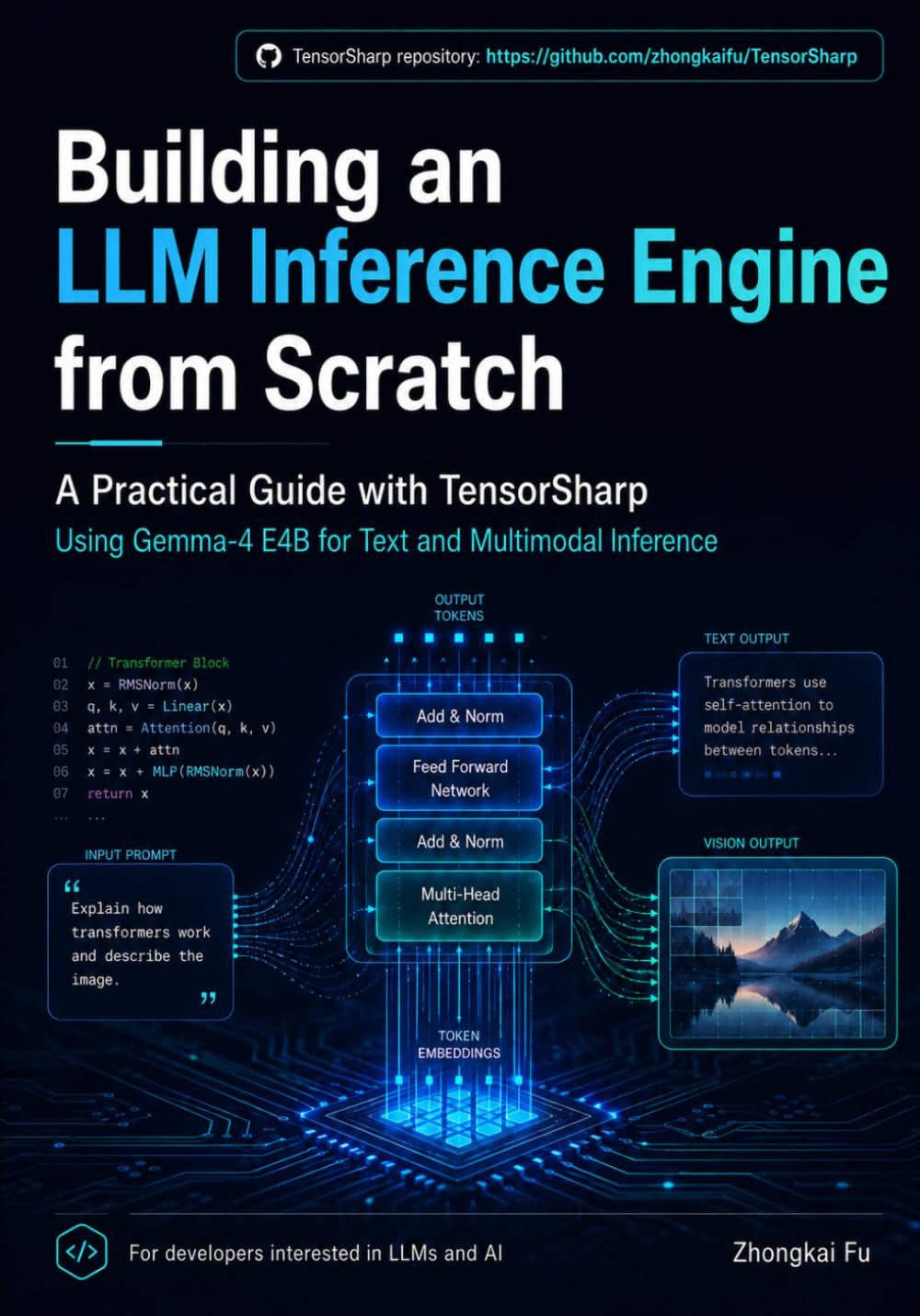
The book follows a deliberately implementation-driven sequence. Each layer earns its place before the next abstraction is introduced, so the complete system stays understandable from first allocation to final response.
Start with storage, shapes, strides, views, allocation, and operator dispatch—the small contracts every later model operation depends on.
Read GGUF metadata and weights, understand quantization, tokenize prompts, and prepare the values that enter the network.
Trace transformer execution, logits, sampling, stopping, and streaming until a low-level forward pass becomes an interactive reply.
Follow Gemma 4 E4B as image, video, and audio encoders project their inputs into the language model's token stream.
Build a readable CPU reference, validate intermediate and final results, and create a trustworthy baseline before optimizing.
Move to accelerators, paged KV caches, continuous batching, prefix sharing, and speculative decoding without losing the original mental model.
TensorSharp is not presented as a black box. The book connects the concepts directly to the responsibilities an inference engine must fulfill: owning memory, dispatching operators, decoding a portable model format, executing a multimodal transformer, choosing tokens, and serving results efficiently.
Gemma 4 E4B keeps that journey anchored in one concrete example. Its text, image, video, and audio path makes the boundaries between model loading, modality encoders, projection, transformer execution, and output generation visible in the same system.
A companion to the source and reference docs. Read the book for the guided narrative, then use this wiki and the TensorSharp repository to inspect the current commands, APIs, architecture cards, and implementation details.
Move from consuming AI services to understanding the C# systems underneath local inference.
Connect model architecture to memory layout, execution, validation, acceleration, and serving.
Replace disconnected concepts with an end-to-end implementation you can read, run, and explore.
From the first tensor to the next token
Take the implementation-driven route through TensorSharp and Gemma 4 E4B, then return to the repository ready to read the code as a complete system.